The Ancient Roots of Reflexology and Why It Still Matters Today
Introduction
In a world driven by speed, technology, and constant stimulation, it is easy to overlook practices that have endured quietly for thousands of years. Reflexology is one such practice.
Rooted in ancient civilizations and passed down through generations, reflexology reflects an early understanding of the body as an interconnected whole rather than a collection of isolated parts.
While modern medicine has advanced in extraordinary ways, interest in reflexology has not faded. In fact, many people are returning to it precisely because it offers something increasingly rare in modern life. Stillness. Touch. Attention. Presence.
This article explores where reflexology began, how it evolved, and why it continues to hold relevance today.
Early Origins of Reflexology
Ancient Egypt
One of the earliest known references to reflexology appears in ancient Egypt. A wall carving in the tomb of Ankhmahor, dating back to approximately 2330 BCE, depicts practitioners working on the hands and feet of others.
The inscription translates to “Do not let it be painful.” “I shall act so you praise me.”
Historians often point to this image as evidence that therapeutic foot and hand work was already a respected healing practice. The scene suggests communication, care, and awareness of comfort rather than force.
Traditional Chinese Medicine
In China, reflexology developed alongside Traditional Chinese Medicine, which views the body as an integrated system governed by the flow of qi, or vital energy.
According to this framework, qi travels through pathways called meridians. When this flow becomes blocked or imbalanced, illness may arise. The feet were considered powerful points of access because they connect to multiple meridians throughout the body.
The National Center for Complementary and Integrative Health describes Traditional Chinese Medicine as an approach that emphasizes the body as a whole rather than treating symptoms in isolation. This philosophy aligns closely with reflexology’s foundations.
Ayurvedic Foot Care Traditions
In India, Ayurvedic medicine recognized the feet as vital centers of circulation and energy. Daily foot massage, known as padabhyanga, was encouraged as a routine self care practice.
Ayurvedic teachings held that caring for the feet could calm the nervous system, improve sleep, and support long term vitality. Foot care was viewed not as indulgence, but as preventative medicine.
The Development of Modern Reflexology
Zone Therapy
In the early twentieth century, American physician William Fitzgerald introduced the concept of Zone Therapy.
He proposed that the body could be divided into ten vertical zones running from head to toe. Applying pressure within one zone appeared to influence other areas within the same zone.
Fitzgerald’s observations laid the groundwork for modern reflexology and its mapping systems.
Eunice Ingham and Reflex Mapping
Eunice Ingham, a nurse and physiotherapist, expanded on Fitzgerald’s work and is widely regarded as the founder of modern reflexology.
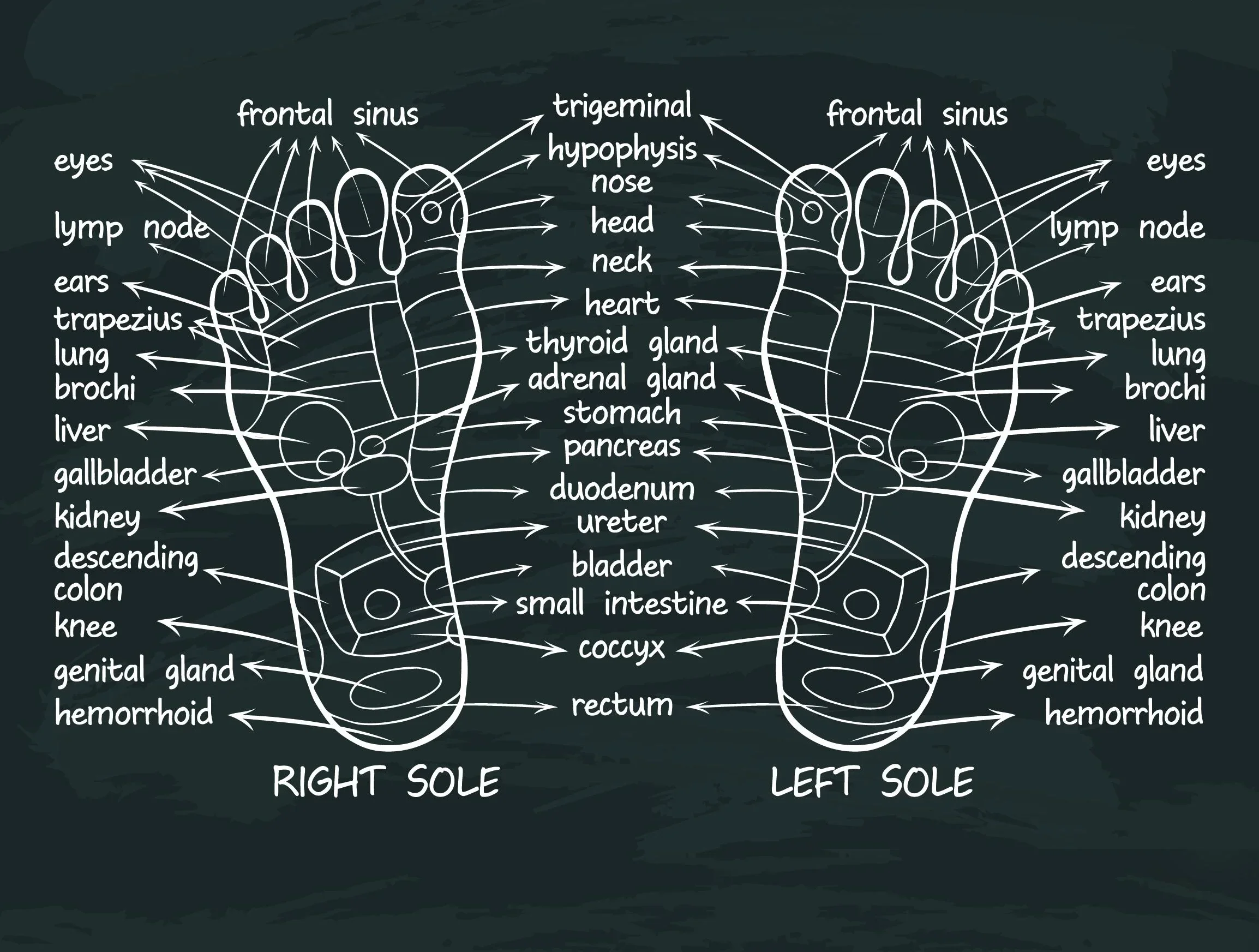
Through years of practice, she developed detailed reflex maps of the feet, correlating specific areas with organs and systems throughout the body.
Ingham believed that imbalances could manifest in the feet and that focused pressure could encourage the body’s natural healing response. Her work transformed reflexology into a structured and teachable discipline.
Why Reflexology Still Matters Today
Despite advances in technology and medicine, reflexology continues to resonate because it addresses needs that remain unchanged.
Supporting the Nervous System
Modern life keeps many people in a near constant state of stress. Reflexology encourages the body to shift out of fight or flight and into rest and restore.
Harvard Health Publishing explains that relaxation techniques involving touch can lower stress hormones, reduce heart rate, and support immune function. Reflexology appears to work through this same physiological pathway.
Honoring the Body as a Whole
Rather than isolating symptoms, reflexology reflects the understanding that the body functions as an interconnected system.
The Cleveland Clinic describes holistic approaches as those that support the body’s natural ability to heal by addressing physical, emotional, and lifestyle factors together. Reflexology fits seamlessly within this framework.
Preserving the Power of Human Touch
In a time when machines can simulate massage and technology can automate care, reflexology remains deeply human.
Psychologist Tiffany Field, founder of the Touch Research Institute, has emphasized that touch is fundamental to emotional and physical health throughout life.
Reflexology requires presence, attunement, and responsiveness. It is not just pressure. It is relationship.
Reflexology and Modern Research
While reflexology originated long before modern science, research continues to explore its effects.
Studies suggest reflexology may help reduce stress, improve sleep quality, ease pain, and enhance overall wellbeing. Researchers often attribute these benefits to nervous system regulation, improved circulation, and the relaxation response created by focused touch.
A review published in the Journal of Complementary and Integrative Medicine notes improvements in anxiety levels and quality of life when reflexology is used as a complementary practice.
Reflexology in a Digital World
As artificial intelligence, automation, and digital tools become more common, many people report feeling disconnected from their bodies.
Reflexology offers a counterbalance. It invites people to slow down, to feel, and to reconnect with physical sensation.
Rather than measuring health through data alone, reflexology encourages listening. It asks what the body is communicating and responds with care rather than force.
In this sense, reflexology is not outdated. It is timeless.

Why People Continue to Seek Reflexology
People return to reflexology not because it is trendy, but because it fulfills fundamental human needs.
- It provides calm in a noisy world.
- It offers care without urgency.
- It supports balance rather than control.
- It reconnects people to their bodies.
These needs persist regardless of how advanced society becomes.
Conclusion
Reflexology has endured for thousands of years because it addresses something essential. The need for touch. The need for connection. The need to feel supported rather than fixed.
From ancient Egyptian tombs to modern wellness spaces, reflexology continues to remind us that healing does not always require complexity. Sometimes it begins with attentive hands, patient presence, and a willingness to listen.
In a world that moves faster every day, reflexology invites us to slow down and remember what has always mattered.