The Autumn Reset: What Happens to Your Body When the Seasons Change, and How to Respond

There is a reason October feels different. The air cools, the light softens, and something in the body shifts in response. Leaves changing color is the version of seasonal change we are taught to notice, but inside the human body, the transition from summer into autumn triggers a cascade of physiological adjustments that are equally dramatic, if far less celebrated. Understanding what those changes are, and how to support the body through them, is one of the more practical things any of us can do for our long-term health.
Modern wellness culture has conditioned many of us to treat self-care as a summer activity, a seasonal indulgence tied to lighter clothes and longer days. In truth, autumn is the season when the body most needs attention. It is the season of transition, and transitions are precisely when the body is most vulnerable and most receptive to support.
How the Body Responds to Shorter Days
As daylight hours shorten, the pineal gland increases its production of melatonin, the hormone most commonly associated with sleep. This is a natural, biological response to the changing light environment. The consequence is not only that we feel sleepier earlier in the evening. It also means that circadian rhythms shift, energy levels throughout the day change, and the body begins to recalibrate its internal clock. Many people experience this as a vague fatigue that arrives in October and refuses to be explained by any single cause. At the same time, cortisol patterns, which govern our alertness and stress response, can become dysregulated as the body adjusts to new light cues. Research published in the journal
Psychoneuroendocrinology has documented measurable differences in cortisol output across seasons, with autumn representing a period of particularly notable flux. For people already managing high stress loads, this seasonal shift can compound existing tension in the nervous system.
Beyond hormonal changes, cooler temperatures prompt the cardiovascular system to redirect blood flow toward the body's core in order to protect vital organs and regulate temperature. This process, known as peripheral vasoconstriction, reduces circulation to the extremities, particularly the hands and feet. For people who already struggle with poor circulation, autumn is often when symptoms become most noticeable.
The Immune System and the Seasonal Shift
The arrival of cold and flu season is not a coincidence. As temperatures drop, the mucous membranes that line the nose and throat, the body's first line of defense against airborne pathogens, become drier and less effective at trapping and eliminating foreign particles. Simultaneously, people spend more time indoors in closer proximity to one another, increasing exposure to circulating viruses. The immune system, which is itself affected by stress levels, sleep quality, and circulatory efficiency, is being asked to perform at a higher level precisely when several of its supporting conditions are being compromised.
The lymphatic system plays a central role in immune function that often goes unacknowledged. Unlike the cardiovascular system, the lymphatic network has no dedicated pump. It relies on muscle movement, deep breathing, and manual stimulation to move lymph fluid through the body. When circulation slows and physical activity decreases, as it often does in autumn when outdoor exercise becomes less appealing, lymphatic flow can stagnate. This creates conditions in which metabolic waste and pathogens are not efficiently cleared from the tissues.
What Reflexology Can Do for a Body in Transition
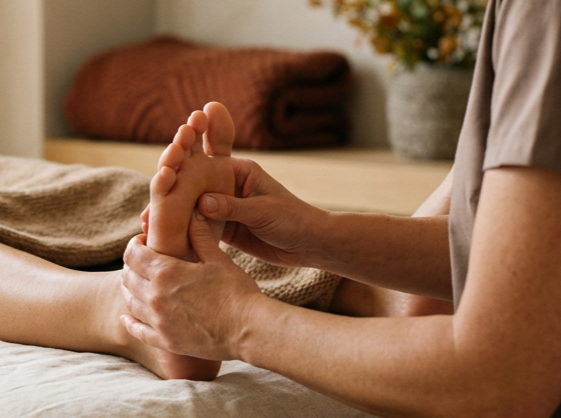
Reflexology is a therapeutic practice built on the principle that specific points on the feet correspond to organs, glands, and systems throughout the body. When these points are worked through deliberate pressure, the goal is to encourage the connected region to release tension, restore circulation, and return to a state of balance. From the perspective of seasonal care, reflexology offers a targeted and measurable way to address several of the physiological challenges that autumn introduces.
Circulation is perhaps the most direct benefit. A 2014 study published in the Journal of Traditional Chinese Medicine found that foot reflexology produced significant improvements in peripheral blood flow among participants, effectively counteracting the vasoconstriction that cooler weather induces. For clients who arrive at a session with cold feet and a sense of sluggishness, this outcome is often immediately perceptible.
The immune system also has a reflex zone on the feet. Points corresponding to the spleen, thymus, and lymphatic system can be specifically targeted during a reflexology session to encourage immune activation and lymphatic drainage. Research from Cardiff Metropolitan University has explored reflexology as a complementary therapy for managing lymphoedema, documenting its capacity to support lymphatic movement in clinical populations. While these studies focus primarily on therapeutic applications, the underlying mechanism, improved lymphatic circulation through targeted foot pressure, has clear relevance for anyone seeking to strengthen their seasonal immune resilience.
Perhaps most importantly for the autumn context, reflexology activates the parasympathetic nervous system, shifting the body out of the chronic fight-or-flight state that high cortisol levels sustain. This parasympathetic response is sometimes called the rest-and-digest state, and it is precisely this state that allows the body to repair, restore, and defend itself. When the nervous system is chronically activated by stress, immune function is suppressed, sleep quality deteriorates, and digestion becomes compromised. A reflexology session interrupts that cycle in a meaningful and measurable way.
The Case for Whole Body Massage in October
While foot reflexology addresses the body systemically through its reflex zones, the autumn season often calls for something more physically encompassing. Muscles that are tighter in cold weather, a nervous system navigating new hormonal patterns, and a body that has been working harder to maintain internal temperature all benefit from the broader release that a full-body massage provides.
At BAO, our Whole Body Massage begins with reflexology on the feet and carries that release upward through the legs, back, shoulders, neck, and scalp. This approach is deliberate. By establishing foundational work at the reflex points first, the body's overall receptivity to deeper tissue release is significantly increased. Clients who come in holding tension in the shoulders and neck will often find that releasing it becomes easier once the reflexology work has shifted the nervous system into a more relaxed state.
For those dealing with specific areas of muscular tension, perhaps from increased time at a desk as outdoor routines become less consistent, our Targeted Body Massage offers the flexibility to focus precisely where relief is most needed. The two treatments can also be used in combination or rotated across sessions, depending on what the body is asking for at any given time.
Building an Autumn Wellness Routine
The most effective approach to seasonal wellness is not reactive. Waiting until a cold takes hold, until fatigue becomes difficult to manage, or until tension in the body becomes pain means beginning from a position of deficit. A proactive approach, building regular bodywork into the routine before the season's challenges peak, produces substantially better outcomes.
Many of our clients find that a session every two to three weeks through October and November provides a consistent foundation of support through the seasonal shift. For those who prefer flexibility, a membership plan allows you to maintain that rhythm without the friction of scheduling individual sessions each time. Others choose a prepaid package, which extends the same value and ensures that the treatment is available whenever the body calls for it.
Beyond professional bodywork, there are simple daily practices that support what happens in a session. Staying well hydrated helps the lymphatic system maintain its flow. Prioritizing sleep, particularly as melatonin production naturally increases, allows the body to undergo the cellular repair processes that immune function depends on. Gentle movement such as walking, stretching, or yoga keeps peripheral circulation active even as the season discourages more vigorous outdoor exercise.
The Body Knows What Season It Is
One of the more quietly profound aspects of human physiology is how deeply the body is in conversation with its environment. We did not evolve to operate at a uniform intensity across all twelve months. The autumn shift toward slower rhythms, longer rest, and inward attention is not a failure of energy or motivation. It is the body doing precisely what it was designed to do.
The role of thoughtful self-care in this season is not to fight that natural deceleration, but to support it. Foot reflexology, massage therapy, and the kind of deliberate rest that good bodywork encourages are not luxuries to be deferred until life slows down on its own. They are the tools that allow the body to navigate transition with resilience rather than depletion.
If October is asking you to slow down, the wisest response is to listen. We are here when you are ready.
BAO FOOT SPA offers Foot Reflexology, Whole Body Massage, and Targeted Body Massage at our Santa Monica and Beverly Hills locations. Memberships, prepaid packages, and gift cards are available online at baofootspa.com.